
Truck crash on Southern Boulevard, Okeechobee Boulevard or the Turnpike: how to preserve the evidence
After a commercial truck crash, the carrier should be put on written notice to preserve its electronic logging device records, engine and event data, dash-cam video, driver qualification file, post-crash drug and alcohol test results, and inspection and maintenance records. Federal rules require carriers to keep hours-of-service records for only six months (49 C.F.R. § 395.8(k)), and nothing in those rules requires them to keep dash-cam video, so a preservation letter should go out as soon as possible. Florida applies most of the same federal safety rules to intrastate trucks through Fla. Stat. § 316.302.
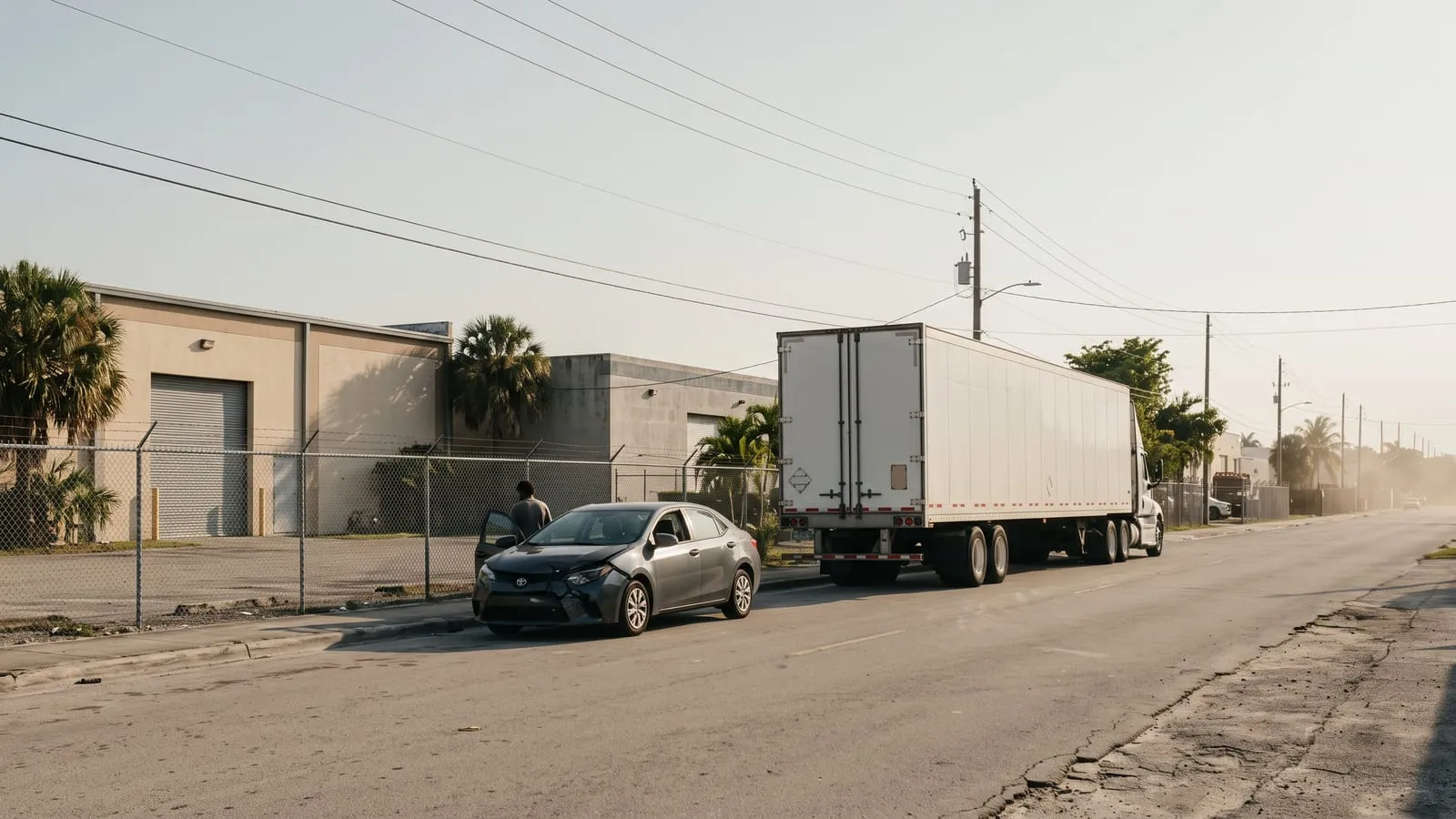
Heavy trucks are part of daily traffic in Palm Beach County. Tractor-trailers run the Turnpike and I-95 all day. Southern Boulevard carries trucks between West Palm Beach and the western communities, out past Wellington and Loxahatchee toward Belle Glade. Okeechobee Boulevard connects downtown to the Turnpike, and the Port of Palm Beach in Riviera Beach handles cargo as well as cruise passengers. When a truck causes a crash, the case is usually decided less by what people remember and more by what the carrier’s own records show, and those records do not wait around.
Why is a truck crash case different from a car crash case?
Because a commercial truck operates inside a web of federal regulation that ordinary drivers never deal with. The Federal Motor Carrier Safety Regulations, found in Title 49 of the Code of Federal Regulations, govern how long a driver can be behind the wheel, how the truck must be inspected and maintained, how drivers are screened and tested, and how much insurance the carrier must carry. Florida applies most of those rules to commercial vehicles operating within the state as well, with listed modifications (Fla. Stat. § 316.302).
Every one of those rules produces records. Those records can show whether the driver was fatigued, whether the brakes were maintained, whether the carrier should have hired this driver in the first place, and what the truck was doing in the last seconds before impact.
What records does a trucking company have, and how long must it keep them?
The answer varies by category, and some of the most useful evidence has no federal retention requirement at all.
| Evidence | What it can show | Federal retention rule |
|---|---|---|
| Electronic logging device data and supporting documents | Hours driven, breaks, location over time | 6 months (49 C.F.R. § 395.8(k)) |
| Engine control module and event data | Speed, braking and throttle before impact | No specific federal rule; can be lost when the truck is repaired or put back in service |
| Dash-cam and in-cab video | The road ahead and the driver’s actions | No federal rule; many systems overwrite on a rolling basis |
| Driver qualification file | License, medical certificate, employment checks, prior violations | Kept while the driver is employed and for 3 years after (49 C.F.R. part 391) |
| Inspection, repair and maintenance records | Condition of brakes, tires, lights | Kept for 1 year and for 6 months after the vehicle leaves the carrier’s control (49 C.F.R. § 396.3) |
| Post-accident drug and alcohol test results | Impairment | Required testing after qualifying crashes (49 C.F.R. § 382.303); results kept under part 382 |
| Dispatch, load and delivery records | Schedule pressure, route, who the shipper and broker were | Varies |
Hours-of-service rules are a frequent issue. A property-carrying driver may drive no more than 11 hours after 10 consecutive hours off duty, and may not drive beyond the 14th hour after coming on duty (49 C.F.R. § 395.3). ELD data is how a violation gets proven, and the six-month retention period starts running from the day the records are created, not from the day you hire a lawyer.
What does a preservation letter do, and when should it be sent?
A preservation letter is a written notice to the carrier, its insurer, and any other company involved, such as the trailer owner, the broker or a maintenance shop. It states that a claim exists, identifies the crash by date, time and place, and lists the specific categories of evidence that must be kept. It should be sent in a way that proves delivery.
Once a company is on notice that litigation is likely, destroying relevant evidence exposes it to sanctions in Florida courts, which can include an instruction allowing the jury to infer the lost evidence would have hurt the company. Before notice, a carrier that deletes a dash-cam clip on its normal schedule may face no consequence at all. That is why timing matters. The letter should go out in the first days after the crash, not after treatment is finished.
If the truck has been towed, the letter should also ask that it not be repaired, sold or returned to service until its data has been downloaded and the vehicle inspected. A truck that goes back on the road on Southern Boulevard the following week may carry the key evidence away with it.
Who can be responsible besides the driver?
Commercial trucking usually involves several companies. The motor carrier that employs or contracts with the driver is the most obvious. But the tractor and trailer may be owned by different entities, a freight broker may have arranged the load, a shipper may have loaded it unevenly, and an outside shop may have serviced the brakes. Each may share fault under Florida’s apportionment statute, and each may carry its own insurance (Fla. Stat. § 768.81(3)).
Federal minimum liability coverage for interstate general freight carriers is $750,000, with higher minimums for certain hazardous materials (49 C.F.R. § 387.9). Intrastate carriers may be subject to different requirements. Identifying every company involved, from the paperwork and the markings on the truck, is part of the early work.
Who investigates a truck crash in Palm Beach County?
On the Turnpike and I-95, the Florida Highway Patrol (Troop L) usually investigates. On Southern Boulevard, Okeechobee Boulevard and other surface roads, it may be the West Palm Beach Police Department, the Palm Beach County Sheriff’s Office or a city police department, depending on location. Serious truck crashes sometimes involve specialized commercial vehicle enforcement officers. The crash report is available through the Florida Crash Portal, with access limited to the parties and certain others for 60 days (Fla. Stat. § 316.066).
Carriers and their insurers often send their own investigators to the scene quickly, sometimes the same day. That is normal practice in the industry, and it is the reason the injured person’s side needs to move quickly too.
What should I do while I recover?
Follow through on medical care, starting within 14 days to protect your Personal Injury Protection benefits (Fla. Stat. § 627.736(1)(a)). Keep photos of the vehicles and your injuries. Write down the company name on the truck door, any USDOT number you saw, the trailer markings and the direction the truck was traveling. Do not give the trucking company’s insurer a recorded statement, and do not sign anything it sends.
Contact Wolfson & Leon
Wolfson & Leon has represented injured people since 1963. If a commercial truck hit you anywhere in Palm Beach County, call 561-782-1585 to arrange an appointment at our West Palm Beach office. The consultation is free, in English or Spanish. If we take your case, we explain the contingency fee in writing before you sign, the firm advances case costs, and the preservation letter goes out as soon as we are retained.
Key facts
- Motor carriers must retain records of duty status and supporting documents for six months. Source: 49 C.F.R. § 395.8(k)
- Property-carrying drivers may drive up to 11 hours after 10 consecutive hours off duty, within a 14-hour window. Source: 49 C.F.R. § 395.3
- Post-accident drug and alcohol testing is required after crashes involving a fatality, and after certain injury or tow-away crashes when the driver receives a citation. Source: 49 C.F.R. § 382.303
- Interstate carriers of general freight must carry at least $750,000 in public liability coverage. Source: 49 C.F.R. § 387.9
- Florida applies the federal motor carrier safety regulations, with listed modifications, to commercial vehicles operating within the state. Source: Fla. Stat. § 316.302
Frequently asked questions
The truck was a local dump truck, not an 18-wheeler. Do the federal rules still matter?
Often, yes. Florida adopts most of the federal motor carrier safety regulations for commercial vehicles operating inside the state, with some modifications (Fla. Stat. § 316.302). Which rules apply depends on the vehicle's weight, cargo and whether the carrier crosses state lines.
The trucking company's insurer wants a statement. Should I give one?
You are not required to give the trucking company's insurer a recorded statement. Carriers often begin investigating within hours, and what you say may be used to shift blame. Get medical care and speak to a lawyer first.
How long do I have to sue after a truck crash?
For crashes on or after March 24, 2023, Florida's general negligence deadline is two years (Fla. Stat. § 95.11(5)(a)). The practical deadline for evidence is much shorter, because some records can be lawfully discarded within months or overwritten within days.
This article describes Florida law in general terms for people in Palm Beach County. It is not legal advice about your situation, and reading it or contacting us does not create an attorney-client relationship with Wolfson & Leon. Results in past cases do not predict or promise the result in any other case.