
I was hurt on my motorcycle in Palm Beach County. If PIP doesn't cover riders, who pays?
After a motorcycle crash in Palm Beach County, your medical bills are paid by your health insurance, any MedPay on your motorcycle policy, and in the end the at-fault driver's bodily injury coverage or your own uninsured motorist coverage, because Florida's PIP system does not cover motorcycles (Fla. Stat. § 627.732(3)). The upside of being outside that system is that a rider does not have to prove a permanent injury to claim pain and suffering from the driver who caused the crash. Since Florida does not require most drivers to carry bodily injury coverage, checking every policy in your household for uninsured motorist coverage is one of the first steps.
Wolfson & Leon has represented injured people, riders among them, since 1963. A consultation costs nothing and can be held in English or Spanish. Fees are contingency-based, with the percentage spelled out in writing before you sign, and the firm advances case costs. To meet at the West Palm Beach office, which is by appointment only, call 561-782-1585.
With no PIP, how do my hospital bills get paid in the meantime?
In the months between the crash and a settlement, bills are usually covered by your health insurance, by medical payments (MedPay) coverage if you bought it on the motorcycle policy, and by doctors who agree to treat you under a letter of protection and be paid from the recovery. The at-fault driver's bodily injury (BI) liability coverage pays when the case resolves. Because that coverage is optional in Florida and plenty of drivers go without it, the uninsured motorist (UM) coverage on your motorcycle policy, or on a car policy in your household, is often the largest source of payment available.
If I wasn't wearing a helmet, can the insurance company use that against me?
It can try, but only within limits. Riders 21 or older may legally ride without a helmet if they have at least $10,000 in medical benefits coverage (Fla. Stat. § 316.211(3)(b)), and eye protection is required for everyone. Going without a helmet under those conditions is not negligence on its own. What an insurer will argue is that a head injury would have been less severe with one, and under comparative fault (Fla. Stat. § 768.81) a jury may cut the award by a percentage for that choice. A broken leg, a shoulder injury or road rash has nothing to do with a helmet, and that argument does not reach those damages.
The driver says they never saw me. Does that get them off the hook?
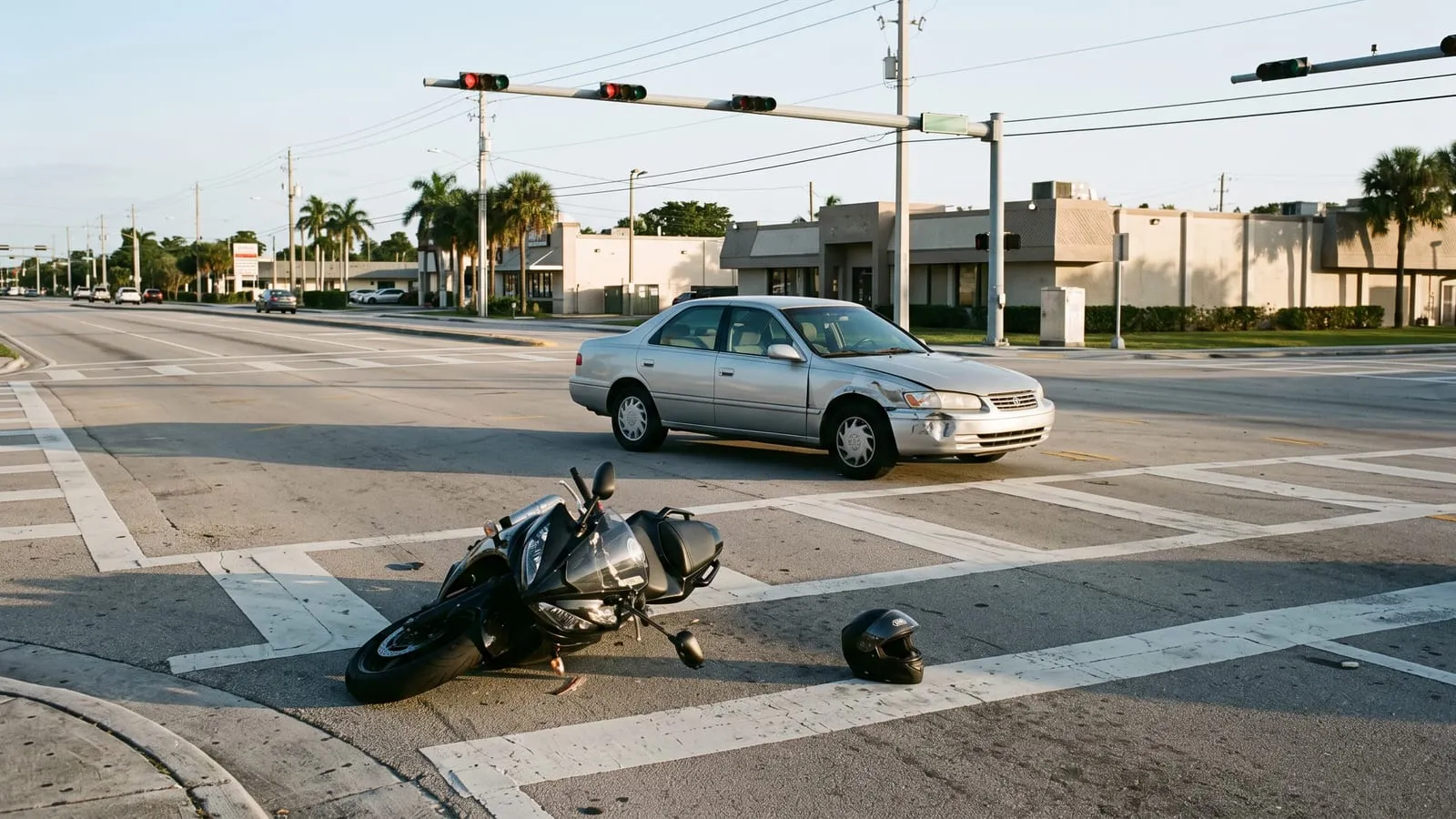
No. One of the most common motorcycle crashes is a car making a left turn in front of an oncoming rider at an intersection or a driveway. Florida requires a driver turning left to yield to oncoming traffic close enough to be an immediate hazard (Fla. Stat. § 316.122). Saying they did not see the motorcycle is really an admission that they did not look carefully enough. The crash report, independent witnesses, nearby cameras and the damage to the bike and the car are what establish that the rider had the right of way.
Which Palm Beach County roads should riders watch most closely?
Wide, multi-lane roads with frequent left turns into shopping centers and side streets set up the classic left-turn crash, and Okeechobee Boulevard, Military Trail, Congress Avenue, Forest Hill Boulevard, Lake Worth Road and State Road 7 / US 441 all fit that pattern. Near the coast, riders share US 1, Dixie Highway and Flagler Drive with slow-moving visitors and sudden stops, while Southern Boulevard heading west toward Belle Glade mixes fast traffic with heavy trucks. On I-95 and the Turnpike, the danger is drivers changing lanes without checking their mirrors.
Keep in mind that riding between lanes of stopped or slow traffic is illegal in Florida (Fla. Stat. § 316.209(3)), and an insurer will look for any sign of it in the crash report and witness statements.
What should I do right after a motorcycle crash?
Get evaluated at a hospital the same day, even if you were able to ride away, because adrenaline masks injuries; St. Mary's Medical Center and Delray Medical Center are the county's Level I trauma centers. Leave the motorcycle, helmet, jacket and gloves exactly as they are, since they show the force and direction of the impact. Photograph the car, its plate and the scene, and get names and phone numbers from anyone who stopped. In rider cases the two versions of events often conflict, so a neutral witness carries real weight. Wait to talk to the driver's insurer until you have spoken with a lawyer.
What can a rider recover after a crash someone else caused?
With motorcycles left out of the no-fault system, the permanent-injury threshold in Fla. Stat. § 627.737 does not apply to a rider's claim against the driver at fault. Medical expenses, lost earnings, and pain and suffering are all available for any injury the driver caused, permanent or not. What usually limits the recovery is insurance: the driver's bodily injury coverage, if they have it, and your own UM coverage, which is why the firm asks for every auto and motorcycle policy in your household at the first meeting. Damage to the motorcycle and your gear is handled as a separate property claim.
Which mistakes can cost a rider the claim?
- Fixing or throwing away the bike, helmet or riding gear. They show impact, speed and injury, so store them untouched.
- Discussing your speed or helmet use on a recorded call with the other driver's insurance company.
- Leaving the scene without witness contact information. The driver's account will likely differ from yours, and a neutral witness can settle it.
- Skipping the emergency room because you could still ride. A delay in treatment becomes the insurer's main defense.
- Giving up because the driver had no insurance before checking every household policy for uninsured motorist coverage.
Key facts
- Motorcycles fall outside Florida's no-fault PIP system, so riders have no PIP benefits. Source: Fla. Stat. § 627.732(3), § 627.733
- Riders 21 and over may go without a helmet if they carry at least $10,000 in medical benefits; eye protection is required for all riders. Source: Fla. Stat. § 316.211
- A left-turning driver must yield to oncoming traffic close enough to be an immediate hazard. Source: Fla. Stat. § 316.122
- Riding between lanes of traffic (lane splitting) is prohibited in Florida. Source: Fla. Stat. § 316.209(3)
- Operating a motorcycle in Florida requires a motorcycle endorsement on your driver license. Source: Fla. Stat. § 322.12(5)
- Crashes on or after March 24, 2023 carry a two-year deadline to file a negligence lawsuit. Source: Fla. Stat. § 95.11
Frequently asked questions
The driver who caused the crash carries no bodily injury coverage. Where does that leave me?
Look for uninsured motorist (UM) coverage on every policy in your household: your motorcycle policy, your car policy, and policies belonging to relatives who live with you. UM stands in for the driver who did not carry coverage. Bring all of those policies to the consultation so they can be reviewed together.
As a rider, do I need a permanent injury to claim pain and suffering?
No. The permanent-injury requirement in Fla. Stat. § 627.737 is part of the no-fault system, and motorcycles are not in that system. A rider can claim pain and suffering for any injury the at-fault driver caused.
I ride without a helmet. Can I still make a claim?
Yes. If you were at least 21 and had $10,000 in medical coverage, riding without one was legal. The insurer may argue that a head injury would have been less serious with a helmet, which can affect the amount, but it does not take away your right to claim.
I may have been a little over the speed limit. Is my case over?
Not necessarily. Florida reduces your recovery by your percentage of fault and only bars it if you were more than 50% responsible (Fla. Stat. § 768.81(6)). When a car turns left across a rider's path, most of the fault usually lands on the driver even if the rider was going a bit fast.
Does the 14-day treatment rule apply after a motorcycle crash?
The 14-day rule belongs to PIP (Fla. Stat. § 627.736), and riders have no PIP for a motorcycle crash. Prompt treatment still matters, though: a delay hands the insurer an argument that you were not hurt or that something else caused the injury.
What happens when you call
Someone from the firm picks up
Dial 561-782-1585 day or night. A person answers, in Spanish if you like; if you call in the small hours, we take your details and an attorney calls you early the next morning.
A short conversation about what happened
About 15 minutes: the date and place, whether a doctor has seen you, whether police wrote a report, and whether any insurer has reached out. No documents needed.
A straight answer
If it is a case the firm can take, we explain the next step and what to avoid in the meantime. If it is not, we say so plainly and point you to where else to turn.
Nothing up front
The firm works on a contingency fee, a percentage explained in writing before you sign. Meetings in West Palm Beach are by appointment, and if you cannot travel, a visit at home or in the hospital can be arranged.
Nothing published on this topic yet. Call the firm and ask your question directly.