
Crash on I-95 or Florida's Turnpike in Palm Beach County: who investigates and who pays
Each injured person's own Personal Injury Protection pays the first medical bills regardless of fault (Fla. Stat. § 627.736). Beyond PIP, a jury or insurers divide fault among every driver who contributed, and each at-fault driver pays only its own percentage, because Florida no longer applies joint and several liability in negligence cases (Fla. Stat. § 768.81(3)). An injured driver found more than 50 percent at fault recovers nothing from the others (Fla. Stat. § 768.81(6)).
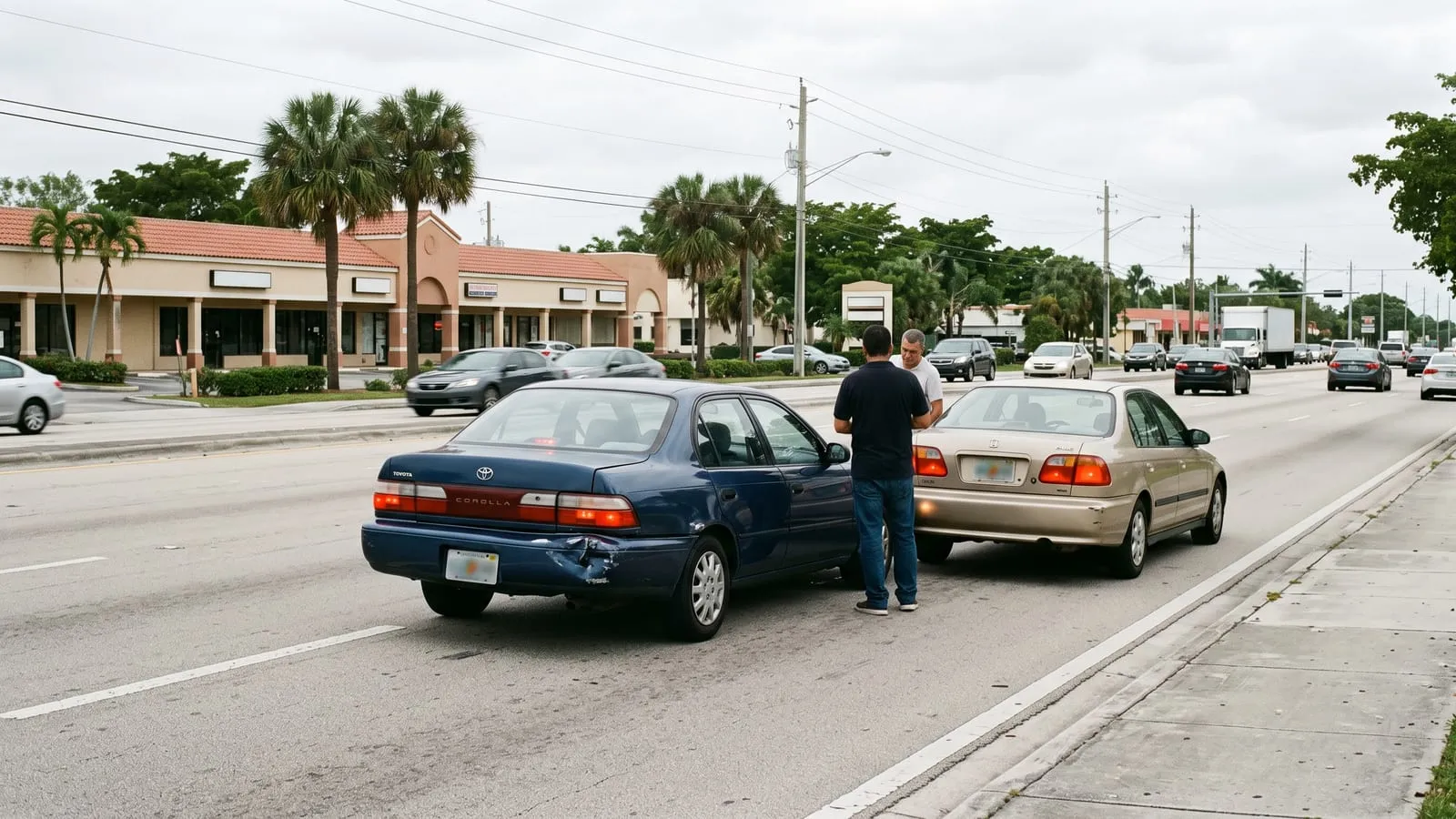
Highway crashes in Palm Beach County rarely involve just two cars. Traffic on I-95 between Palm Beach Lakes Boulevard and Southern Boulevard can go from highway speed to a dead stop in seconds, and the Turnpike near Lake Worth Road and Boynton Beach Boulevard is not much different at rush hour. When a lane closes or someone brakes hard, the cars behind fold into each other. Afterward, everyone involved asks the same two questions: who is in charge of figuring out what happened, and whose insurance pays for it.
Who shows up after a crash on I-95 or the Turnpike?
On the interstate and the Turnpike, the investigating agency is usually the Florida Highway Patrol. FHP is organized into troops, and Troop L covers Palm Beach County. A trooper will collect driver and insurance information, take statements, photograph the scene and, in many injury crashes, write a long-form report with a diagram showing where each vehicle ended up. Fire Rescue crews from Palm Beach County or the nearest city handle transport, often to St. Mary’s Medical Center or Delray Medical Center, both Level I trauma centers.
The report is the starting point, not the final word. Troopers arrive after the fact and work from what drivers tell them and where the cars came to rest. In a chain reaction, the cars in the middle frequently get described as having “struck” the car ahead, when in reality they were pushed. Reading the narrative closely, and comparing it to vehicle damage and witness accounts, is one of the first things a lawyer does.
You can request the report through the Florida Crash Portal. For 60 days after filing, it is released only to those involved, their lawyers, their insurers and certain others (Fla. Stat. § 316.066).
Is the last car in a pileup always at fault?
Florida courts start from a presumption that a driver who rear-ends another vehicle was negligent, typically for following too closely or not paying attention. But the Florida Supreme Court has made clear that the presumption can be rebutted, and that the front driver’s own carelessness, such as a sudden and unexpected stop in traffic, can be weighed by the jury (Birge v. Charron, 107 So. 3d 350 (Fla. 2012)).
In a multi-car crash, that means fault gets sorted car by car. Consider a typical northbound I-95 scenario near the Belvedere Road exit:
| Vehicle | What happened | How fault may be viewed |
|---|---|---|
| Car A | Changed lanes abruptly and braked to make the exit | Possible share for an unsafe lane change and sudden stop |
| Car B | Stopped in time behind Car A | Likely little or no fault |
| Car C | Was looking at a phone and hit Car B | Likely a substantial share |
| Car D | Was following too closely and hit Car C, pushing it further into Car B | A share for the second impact and the added injuries it caused |
That table is illustrative, not a prediction. Real cases turn on the evidence: dash-cam footage, vehicle event data, the trooper’s measurements, and the accounts of people in other lanes who saw the whole sequence.
How does Florida split the bill when several drivers share the blame?
Under Fla. Stat. § 768.81(3), the court enters judgment against each defendant according to that defendant’s own percentage of fault. Florida abolished joint and several liability in negligence cases, so a driver found 20 percent responsible pays 20 percent of the damages, not the whole amount. If one of the at-fault drivers has no insurance or only minimal coverage, the other drivers do not pick up that share.
Your own percentage matters as well. If you are found partly at fault, your recovery is reduced by that percentage. And under the modified comparative negligence rule adopted in 2023, if you are found more than 50 percent at fault for your own injuries, you recover nothing from the others (Fla. Stat. § 768.81(6)).
Defendants also try to shift blame to people who are not in the lawsuit, such as a driver who cut everyone off and kept going. The statute allows that only if the defendant pleads the nonparty’s fault and proves it at trial.
Whose insurance pays my medical bills right now?
The first money comes from your own policy. Florida’s no-fault system means your Personal Injury Protection pays 80 percent of reasonable medical bills and 60 percent of lost income, up to $10,000, regardless of who caused the crash, as long as you get initial care within 14 days (Fla. Stat. § 627.736). Passengers without their own car insurance are generally covered through a resident relative’s policy or the PIP on the vehicle they were riding in.
Once PIP is used up, the claims move to the at-fault drivers’ bodily injury coverage, one carrier per driver, each responsible for its insured’s share. Because Florida does not require bodily injury coverage, it is common for at least one driver in a pileup to have none. Uninsured and underinsured motorist coverage on your own policy (Fla. Stat. § 627.727) fills that gap if you carry it.
What if a road condition or a Turnpike work zone caused the crash?
Sometimes the cause is not a driver at all: a lane shift with poor markings, missing signs in a work zone, or debris that should have been cleared. Florida’s Turnpike and the interstate system are run by the Florida Department of Transportation, a state agency. A claim against the state follows the sovereign immunity statute, Fla. Stat. § 768.28, which requires written notice to the agency and to the Florida Department of Financial Services before a lawsuit and caps the recovery. Private contractors working in a construction zone can also be responsible and are not protected by those caps. This needs to be looked at early, before the work zone is reconfigured.
What should I do this week?
Get medical care inside the 14-day PIP window, request the FHP report, and write down everything you remember about the cars around you: colors, makes, which lane each was in, and who stopped. Save photos from your phone in their original form. If your car has a dash camera, copy the file before it is overwritten.
Talk with our West Palm Beach office
Wolfson & Leon has handled injury cases for people across Florida since 1963. Our West Palm Beach office meets by appointment; call 561-782-1585 for a free consultation in English or Spanish. We work on a contingency fee, explain the percentage in writing before you sign, and advance the costs of the case.
Key facts
- Judgment is entered against each party based on that party's percentage of fault, not on joint and several liability. Source: Fla. Stat. § 768.81(3)
- A claimant found greater than 50 percent at fault for their own harm may not recover damages. Source: Fla. Stat. § 768.81(6)
- A defendant who wants fault assigned to a nonparty, such as a driver who left the scene, must plead it and prove it at trial. Source: Fla. Stat. § 768.81(3)
- The presumption that a rear driver was negligent can be rebutted, and comparative fault still applies. Source: Birge v. Charron, 107 So. 3d 350 (Fla. 2012)
Frequently asked questions
Which agency investigates a crash on I-95 in West Palm Beach?
Florida Highway Patrol, through Troop L, typically investigates crashes on I-95 and Florida's Turnpike in Palm Beach County. Its reports are available through the Florida Crash Portal, subject to the 60-day confidentiality period in Fla. Stat. § 316.066.
I was the third car in a four-car pileup. Is the last driver responsible for everything?
Not necessarily. Florida law presumes a rear driver was negligent, but that presumption can be rebutted. Fault is divided among every driver whose carelessness contributed, and each one's insurer pays its share.
A car cut everyone off and kept going. Does that hurt my case?
It can complicate it, because the other drivers may try to blame the vehicle that left. They must plead and prove that driver's fault. Your own uninsured motorist coverage may also apply to the unidentified driver's share, depending on your policy.
This article describes Florida law in general terms for people in Palm Beach County. It is not legal advice about your situation, and reading it or contacting us does not create an attorney-client relationship with Wolfson & Leon. Results in past cases do not predict or promise the result in any other case.
 Car accidents
Hit by a Palm Tran bus or a government vehicle in Palm Beach County: notice rules and limits under § 768.28
Palm Tran is part of Palm Beach County government, so an injury claim falls under Florida's sovereign immunity statute, Fla. Stat. § 768.28. Before…
Car accidents Car accident in West Palm Beach: what to do in the first 14 days
Get examined by a doctor, hospital, urgent care or other qualifying provider within 14 days of the crash, because Florida's no-fault law ends your…