
Hit by a Palm Tran bus or a government vehicle in Palm Beach County: notice rules and limits under § 768.28
Palm Tran is part of Palm Beach County government, so an injury claim falls under Florida's sovereign immunity statute, Fla. Stat. § 768.28. Before suing, you must present the claim in writing to the county within three years, and the county then has six months to resolve it before the claim is treated as denied (§ 768.28(6)). Recovery is capped at $200,000 per person and $300,000 per incident unless the Legislature approves more through a claims bill (§ 768.28(5)(a)).
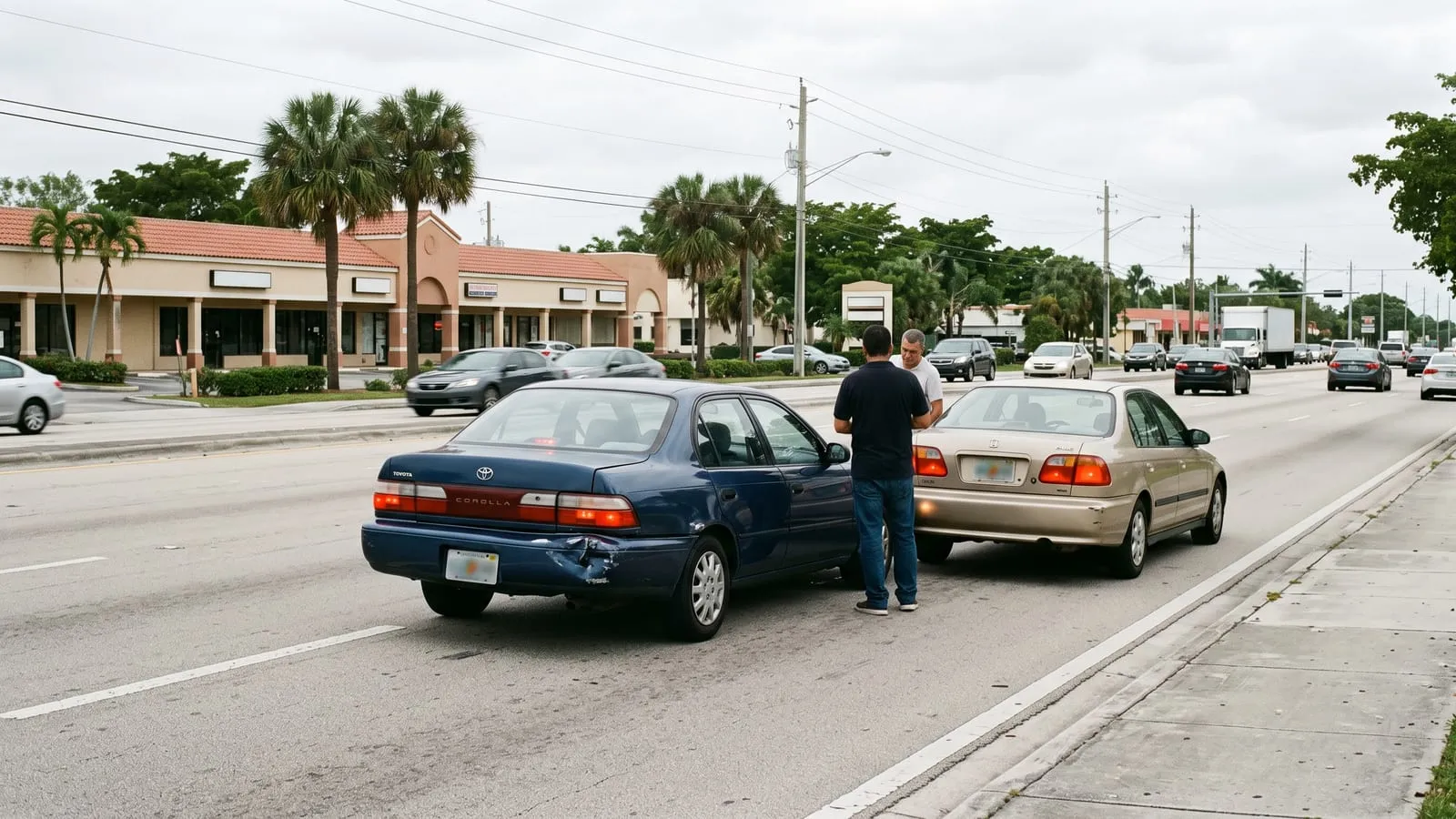
When the vehicle that hit you belongs to the government, the claim changes shape. A Palm Tran bus pulling out on Okeechobee Boulevard, a city garbage truck backing down a West Palm Beach side street, a sheriff’s cruiser running a call on Military Trail: each of these is owned by a public body, and Florida lets you sue that body only on the terms the Legislature has set in Fla. Stat. § 768.28. Those terms are not hard to follow, but they are unforgiving, and the most important ones come before any lawsuit is filed.
Why is a crash with a Palm Tran bus different from a crash with a private car?
Palm Tran is Palm Beach County’s public transit system, which makes it part of county government. Florida’s sovereign immunity statute waives the government’s immunity for ordinary negligence, including careless driving by its employees, but only “to the extent” the statute allows. The same framework covers vehicles owned by the City of West Palm Beach and other municipalities, the Palm Beach County Sheriff’s Office, the School District of Palm Beach County, and state agencies such as the Florida Highway Patrol and the Department of Transportation.
Three rules do most of the work: you must give written notice before suing, the government gets time to investigate, and what it can be made to pay is capped.
What notice has to be sent, to whom, and by when?
Under § 768.28(6)(a), no lawsuit may be filed unless the claimant first presents the claim in writing to the appropriate agency within three years after the claim accrues. For a Palm Tran or other county vehicle, that means Palm Beach County. For a city vehicle, the city. When the claim is against the State of Florida or one of its agencies, such as an FHP patrol car, the written claim must also go to the Florida Department of Financial Services. The statute exempts claims against a municipality or county from that second step.
The notice has content requirements, too. Section 768.28(6)(c) requires the claimant’s date and place of birth and Social Security number, along with a statement of any adjudicated unpaid fines or judgments over $200 owed to the state or its subdivisions, or a statement that there are none. A notice that names the wrong agency or omits required information invites a fight about whether it counts.
Three years can sound generous. It is not, in practice. Evidence like bus camera footage, the operator’s run schedule and maintenance records is easiest to obtain early, and the notice should be sent as soon as the facts are known.
How long until I can actually file a lawsuit?
After the notice is presented, the agency has six months to make a final disposition. If it does not, the claim is deemed denied and suit may be filed (§ 768.28(6)(d)). The lawsuit itself must be commenced within four years after the claim accrues under § 768.28(14), a different period from the two-year negligence deadline that applies to private defendants under Fla. Stat. § 95.11(5)(a).
That difference can cause trouble when a crash involves both a government vehicle and a private one. The private driver’s two-year clock and the government’s notice-and-wait process run side by side, and both have to be managed.
| Step | Rule | Statute |
|---|---|---|
| Written claim to the agency (and to DFS if the state is involved) | Within 3 years after the claim accrues | § 768.28(6)(a) |
| Agency review period | 6 months, then the claim is deemed denied | § 768.28(6)(d) |
| Lawsuit against the government | Within 4 years after the claim accrues | § 768.28(14) |
| Lawsuit against a private driver in the same crash | Generally within 2 years (crashes on or after March 24, 2023) | § 95.11(5)(a) |
How much can the government be made to pay?
Section 768.28(5)(a) caps the government’s liability at $200,000 for any one person and $300,000 for all claims arising out of the same incident. It also bars punitive damages and interest for the period before judgment. A court may enter a judgment above the cap, but the excess may be paid only by a further act of the Legislature, commonly called a claims bill.
Readers may have seen news about raising those numbers. The Florida House passed HB 301 in 2025, but it died in the Senate. In 2026, the Legislature passed HB 145, the companion to SB 1366, and the Governor vetoed it. As of this writing, the $200,000 and $300,000 figures remain the law.
One more limit is easy to overlook: § 768.28(8) caps attorney fees in these cases at 25 percent of any judgment or settlement.
Who else might be responsible besides the government?
Because the cap limits what a public agency pays, it is worth asking early whether anyone else contributed. A private contractor maintaining a bus, a driver who cut in front of the bus, or a company whose truck forced the crash may each be responsible, and none of them benefits from the cap. Your own uninsured or underinsured motorist coverage may also come into play depending on the facts and your policy.
Bus passengers face an extra wrinkle. Florida’s no-fault statute defines motor vehicle in a way that excludes mass-transit vehicles designed for more than five passengers and owned by a city, transit authority or political subdivision (Fla. Stat. § 627.732(3)). That can affect whether Personal Injury Protection applies to someone hurt on or by a Palm Tran bus, so the relevant policies should be read rather than assumed.
What should I do now?
Get medical care, keep every record, and write down the bus route number, the vehicle number painted on the bus, the time and the stop. Ask whether the responding officer was from West Palm Beach Police, PBSO or FHP, and get the report number. Then have the written notice prepared and sent correctly.
Contact Wolfson & Leon
Wolfson & Leon has represented injured people since 1963, including in claims against public agencies. Our West Palm Beach office sees clients by appointment. Call 561-782-1585 for a free consultation in English or Spanish. Our contingency fee is explained in writing before you sign, it follows the 25 percent limit in § 768.28(8) where that statute applies, and the firm advances case costs.
Key facts
- Government liability is capped at $200,000 per person and $300,000 for all claims from the same incident; amounts above that may be paid only by a further act of the Legislature. Source: Fla. Stat. § 768.28(5)(a) (2026)
- The claim must be presented in writing to the agency within 3 years after it accrues; claims against the state, but not against a county or city, must also go to the Department of Financial Services. Source: Fla. Stat. § 768.28(6)(a)
- If the agency does not make a final disposition within 6 months after the claim is filed, the claim is deemed denied. Source: Fla. Stat. § 768.28(6)(d)
- Attorney fees in these claims may not exceed 25 percent of any judgment or settlement. Source: Fla. Stat. § 768.28(8)
- Bills to raise the caps (HB 301 in 2025; SB 1366 / HB 145 in 2026) did not become law; HB 145 was vetoed. Source: Florida Senate bill histories
Frequently asked questions
Can I sue the Palm Tran bus driver personally?
Usually not. Under Fla. Stat. § 768.28(9)(a), government employees are not personally liable for acts within the scope of their job unless they acted in bad faith, with malicious purpose, or with wanton and willful disregard of safety. The claim is against the county.
Does my PIP pay if I was a passenger on the bus?
It may not. Florida's no-fault law defines motor vehicle to exclude mass-transit vehicles that carry more than five passengers and are owned by a city, transit authority or political subdivision (Fla. Stat. § 627.732(3)). Whether any PIP applies depends on how you were hurt and which policies cover you, so have them read.
Can I get more than $200,000 if my injuries are catastrophic?
A court can enter a judgment above the cap, but the government can pay only up to the cap unless the Florida Legislature passes a claims bill authorizing the rest (§ 768.28(5)(a)). Claims bills are uncommon and slow, which is why other responsible parties and your own uninsured motorist coverage are examined early.
This article describes Florida law in general terms for people in Palm Beach County. It is not legal advice about your situation, and reading it or contacting us does not create an attorney-client relationship with Wolfson & Leon. Results in past cases do not predict or promise the result in any other case.
Also available in: Versión en español
 Car accidents
Crash on I-95 or Florida's Turnpike in Palm Beach County: who investigates and who pays
Each injured person's own Personal Injury Protection pays the first medical bills regardless of fault (Fla. Stat. § 627.736). Beyond PIP, a jury or…
Car accidents Car accident in West Palm Beach: what to do in the first 14 days
Get examined by a doctor, hospital, urgent care or other qualifying provider within 14 days of the crash, because Florida's no-fault law ends your…