
Slipped in a West Palm Beach supermarket or store? Florida's spill rule and why the video matters fast
Under Fla. Stat. § 768.0755, a person who slips on a transitory foreign substance in a business must prove the business had actual or constructive knowledge of the dangerous condition and should have acted on it. Constructive knowledge can be shown by evidence that the substance was there long enough that the store should have found it, or that the condition happened regularly and was foreseeable. Store surveillance video is often the clearest proof of how long a spill sat on the floor, so it should be requested in writing right away.
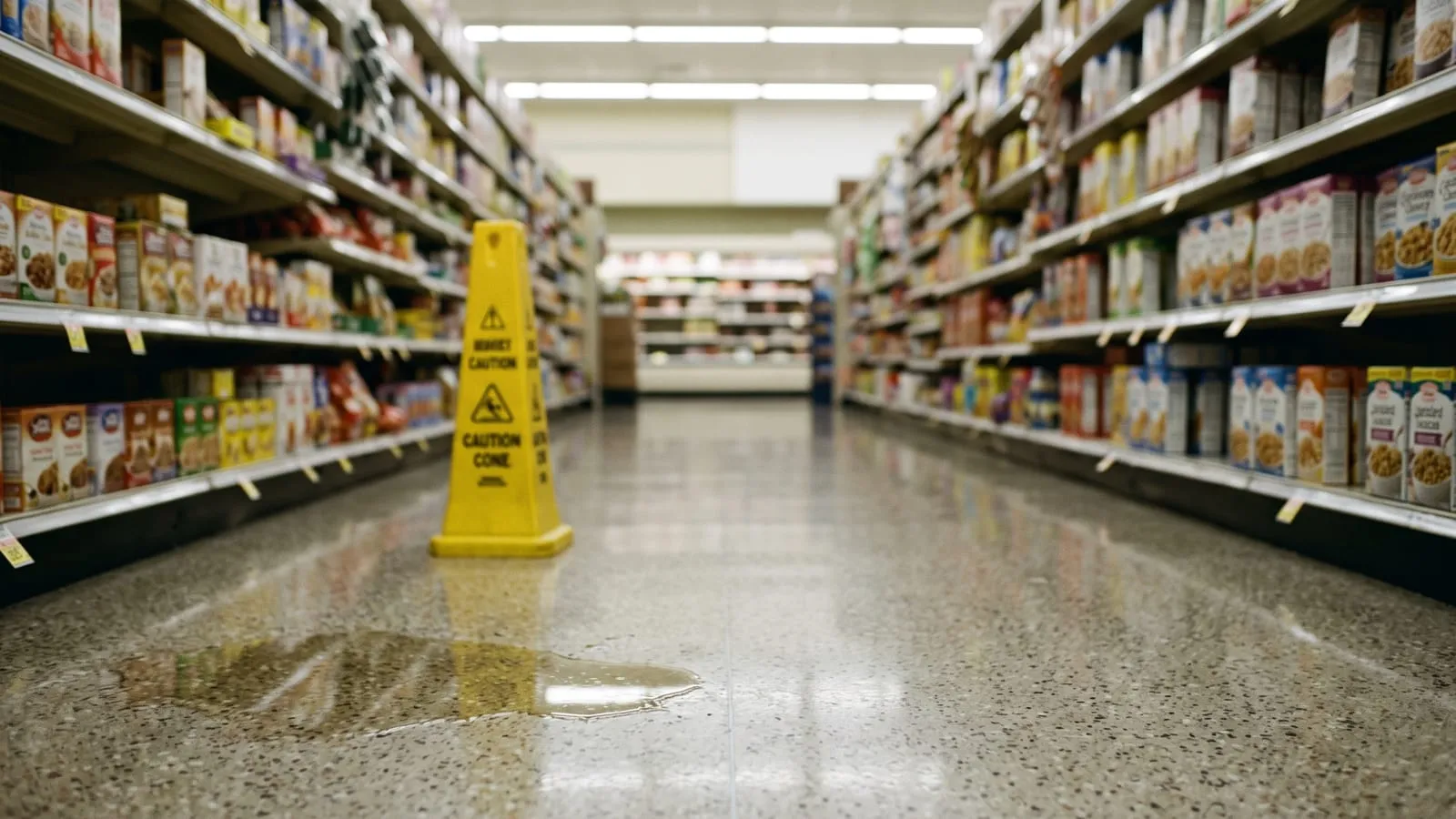
Most people who fall in a store are embarrassed first and hurt second. They get up, insist they are fine, and leave, only to wake up the next morning unable to put weight on a wrist or a knee. By the time they think about a claim, the store has mopped the floor, the shift has changed, and the camera that recorded everything may already be recording over it. In Florida, that footage is often the case. Here is why, and what to do about it.
Why isn’t it enough that the floor was wet?
Because Florida law asks a more specific question. Under Fla. Stat. § 768.0755, when someone slips on a “transitory foreign substance” in a business establishment, such as spilled water, a dropped grape, cooking oil or a leaking freezer case, the injured person must prove the business had actual or constructive knowledge of the dangerous condition and should have taken action to fix it.
Actual knowledge means someone at the store knew: an employee saw the spill, a customer reported it, or a worker was sent to clean it and did not. Constructive knowledge means the store should have known, and the statute lets you prove that with circumstantial evidence in one of two ways:
- the substance had been on the floor long enough that a store using ordinary care would have discovered it, or
- the condition happened with regularity, so it was foreseeable.
A puddle that formed thirty seconds before you stepped in it usually does not meet that test. A trail of liquid that sat in the produce aisle for forty minutes while employees walked past usually does. The difference between those two cases is almost always proven by video.
What does store video show that my memory can’t?
You saw the floor for a second. A camera above the aisle saw it for hours. Footage from before the fall can show when the substance first appeared, where it came from, whether shopping carts tracked it around, whether an employee walked past without stopping, whether a wet-floor sign was ever set out, and how often that spot has had the same problem.
That is the evidence § 768.0755 is asking for, and it belongs to the store. Retailers are not required to save ordinary footage indefinitely, and many systems overwrite on a rolling schedule. Once a store has been told in writing that a claim exists, however, destroying relevant evidence exposes it to sanctions in Florida courts, including an instruction that lets the jury infer the missing evidence would have hurt the store.
How fast does a preservation request need to go out?
As soon as possible after the fall, ideally within days. The request should be in writing, sent to the store location and to the company’s corporate office or claims department, and should identify the date, approximate time, and exact place in the store. It should ask the store to keep:
| What to ask the store to preserve | Why it matters |
|---|---|
| Surveillance video from the area, starting well before the fall | Shows how long the substance was there |
| The incident report and any photos employees took | The store’s own first account |
| Floor inspection, sweep or cleaning logs for that day | Shows whether the store checked the area |
| Employee schedules for the shift | Identifies who was responsible for that section |
| Prior incident reports for the same area | Supports the regularity theory |
| Maintenance records for nearby coolers, roofs or drains | Shows whether a leak was a known problem |
Supermarkets along Okeechobee Boulevard and Forest Hill Boulevard, stores at The Gardens Mall or Palm Beach Outlets, and restaurants around The Square and Clematis Street all fall under the same rule. Many are part of national chains whose claims are handled by a corporate office or insurer far from Palm Beach County, which is one more reason to put everything in writing.
What should I do at the store, before I leave?
If you are able to, take these steps on the spot:
- Tell a manager and ask for an incident report. Ask for a copy, or at least the report number.
- Photograph the floor before it is cleaned, including the substance, its size, any cart tracks and the absence of a warning sign.
- Photograph your shoes and clothing, especially if the substance is on them.
- Get the names and phone numbers of any customers or employees who saw the fall or the spill.
- Do not guess about what happened or say you were not paying attention. Describe only what you know.
Then get medical care, the same day if you can. Falls commonly injure wrists, hips, knees, shoulders and heads, and some of those injuries are not obvious at first. Good Samaritan Medical Center, St. Mary’s and the county’s urgent care centers can document the injury while the timeline is clear.
Will the store blame me for not watching where I was going?
Expect it. Stores routinely argue that a spill was “open and obvious,” that the shopper was distracted, or that footwear was the problem. Florida uses modified comparative negligence: your recovery is reduced by any percentage of fault assigned to you, and you are barred only if you are found more than 50 percent at fault for your own injuries (Fla. Stat. § 768.81(6)). That is another reason the video matters. It shows what a careful shopper in your position could actually have seen.
How long do I have to file?
For falls on or after March 24, 2023, the general deadline for a negligence lawsuit is two years (Fla. Stat. § 95.11(5)(a)). The video deadline is much shorter and is set by the store’s equipment, not by the statute. A fall on public property, such as a county building, follows the separate notice rules in Fla. Stat. § 768.28.
Speak with Wolfson & Leon
Wolfson & Leon has represented injured people since 1963. If you fell in a store anywhere in Palm Beach County, call our West Palm Beach office at 561-782-1585 to set an appointment. The consultation is free and available in English or Spanish. We take these cases on a contingency fee that is explained in writing before you sign, we advance the costs, and we send the preservation request as soon as we are retained.
Key facts
- A person injured by a transitory foreign substance in a business establishment must prove actual or constructive knowledge of the condition. Source: Fla. Stat. § 768.0755(1)
- Constructive knowledge may be proven by circumstantial evidence of how long the condition existed or that it occurred with regularity. Source: Fla. Stat. § 768.0755(1)(a)–(b)
- An injured person found more than 50 percent at fault for their own harm recovers nothing. Source: Fla. Stat. § 768.81(6)
- Negligence lawsuits for injuries on or after March 24, 2023 must generally be filed within two years. Source: Fla. Stat. § 95.11(5)(a)
Frequently asked questions
Does § 768.0755 apply if I tripped on a broken floor tile, not a spill?
No. The statute covers transitory foreign substances, things like liquids, food or debris that do not belong on the floor. A permanent defect, such as a cracked tile, torn mat or uneven threshold, is analyzed under general premises liability law, though notice still matters.
The manager said they would save the video. Is that enough?
Do not rely on a verbal promise. Send, or have a lawyer send, a written preservation request to the store and its corporate office identifying the date, time and location of the fall. A written request creates a record that the store knew a claim was coming.
I was wearing flip-flops and looking at my phone. Can I still make a claim?
Possibly. The store may argue you share the fault, and any share reduces your recovery. You are barred only if you are found more than 50 percent at fault for your own injuries (Fla. Stat. § 768.81(6)).
This article describes Florida law in general terms for people in Palm Beach County. It is not legal advice about your situation, and reading it or contacting us does not create an attorney-client relationship with Wolfson & Leon. Results in past cases do not predict or promise the result in any other case.
Also available in: Versión en español